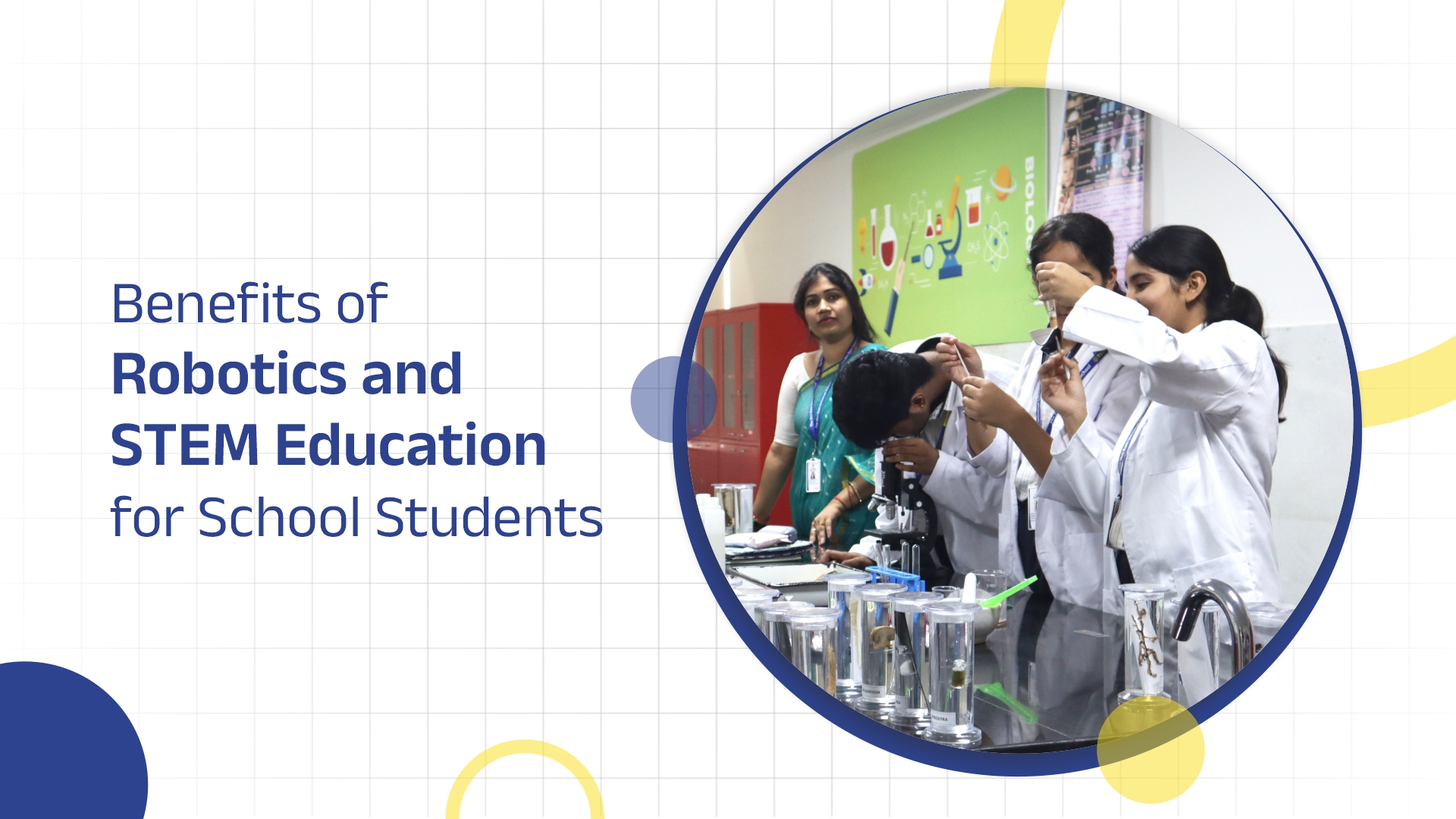
We are living in a world where technology is booming at an unprecedented pace. Therefore, it is crucial for our children to master practical skills and boost creativity and problem-solving abilities to make a mark in this tech-driven world. And that is where robotics education in schools comes into play.
STEM education for students is an interdisciplinary approach that combines science, technology, engineering, and mathematics to help them learn through exploration and experimentation. Robotics promotes further progress in STEM learning by enabling students to design and build robots based on science and mathematics principles and concepts.
From introducing the world of innovation to students to helping them enhance critical thinking skills, there is no denying the benefits of a robotics lab in schools. It certainly takes learning beyond textbooks on a whole new level. Let us learn about the benefits of robotics education in schools.
Boosts Critical Thinking Skills
Two of the most valuable skills that education cultivates are critical thinking and problem-solving. When students are given the task to design and build a robot, they may navigate some challenges, such as creating circuits or writing a computer program.
Overcoming these challenges requires logical thinking and experimentation that fuels students’ potential profoundly. In case the robot fails to perform based on the command, students may analyse the situation from different angles to find a solution. This process will encourage students to think logically and break complex problems into small steps that can be managed one at a time. Robotics education in schools is useful not only in academics but also in real life as students are building skills that will help them make thoughtful decisions.
Makes Learning an Adventure
Back in the days, it was pretty difficult for students to understand complex concepts. That’s because traditional teaching methods focused primarily on theoretical experiences. But that’s not the case with STEM education for students.
One of the biggest STEM learning benefits is that it enhances the curiosity of children, which makes them question different ideas and approaches. Robotics education in schools helps students understand fundamental concepts such as force, motion, electricity, and mathematical equations like nothing else does.
Through experiments and robot-building activities, students can easily understand basic engineering principles that are otherwise tough to grasp with mere theoretical explanations. Indeed, a robotics lab in school works like a charm when it comes to encouraging students to actively participate in classroom activities.
Opens Door to Creativity
Robotics education in schools sets students on the path of creativity and innovation. It provides them with the right opportunities to turn their imaginations into practical solutions.
Teachers can encourage students to develop innovative ideas to address common societal challenges, such as waste collection and improving accessibility for people with disabilities. They can also encourage students to design and build robots to perform simple household tasks as a starting point.
Innovation has a lot to do with experimentation and learning from mistakes. With STEM education, students can learn to solve problems more effectively and efficiently by leveraging technology. By experimenting with different mechanisms, students can explore better solutions to problems and develop their innovative thinking skills.
Supports Future Learning
STEM and Robotics education in schools supports future learning profoundly. It works like a charm in building coding skills for students. Through hands-on activities, robotics education introduces students to programming.
Teachers can begin developing these foundational skills in students based on their age and level. For instance, initially, students may set the ball rolling with visual block-based coding and eventually progress to text-based programming languages. These skills make students more confident in using technology by helping them understand the functionality of digital systems.
Early exposure to these skills promotes continuous learning, preparing them for fields such as computer science, artificial intelligence, and automation, to name a few.
Conclusion
Introducing robotics education in schools is essential for enhancing students’ learning through practical experiences. It works wonders in boosting students’ critical thinking and problem-solving abilities while helping them apply these skills to real life challenges.
Also, robotics education encourages students to adapt to a technology-driven society with confidence. Investing in robotics and STEM education for students is nothing short of empowering the next generation of innovators.
FAQ
- What is STEM and robotics education in schools?
Robotics and STEM education is an interdisciplinary learning approach that combines science, technology, engineering, and mathematics through experiments and hands-on experiences.
- What are the benefits of STEM education?
There are various STEM learning benefits to students. It enhances critical thinking and problem solving skills while fostering creativity and innovation. Also, STEM learning builds confidence and resilience in students and encourages collaboration.
- What is the importance of robotics education in schools?
Robotics education plays an important role in enhancing students’ logical reasoning and coding skills. In addition, it holds utmost importance because it teaches students how to apply theoretical knowledge to real-world situations.
- What is the right starting age for students to learn robotics?
Students between 5 and 7 years of age can explore basic robotics through educational toys and building activities.
- Does robotics and STEM education help students learn coding?
Yes, robotics and STEM education help students build coding skills through practical applications. Teachers introduce programming concepts to students based on their age and abilities, beginning with visual block-based coding and gradually moving forward to text-based programming languages.